Aquaculture operations
A platform that brings together the operations, warehouse and administration of a shrimp larvae lab, with a dashboard that starts from what needs attention.
- Client
- Labreicis · Aquaculture
- Platform
- Desktop + iPad
- Year
- 2025
Context
Labreicis is a shrimp larvae laboratory. Its daily operations include tanks, production runs, water-quality readings and a supplies warehouse.
Much of that information lived in notebooks, spreadsheets and messages between biologists, the warehouse and administration.
Challenge
The lab's operations, warehouse and administration had to come together in one platform, for people who work both in the office and next to the tanks.
The risk was building a complete system that was hard to read day to day, where what's urgent got buried between modules.
Approach
I organised the product into three areas that mirror how the work is split:
- Operations: tanks, runs and tracking.
- Warehouse: inventory, approvals and history.
- Administration: labs and tanks, the supplies catalogue, and users and roles.
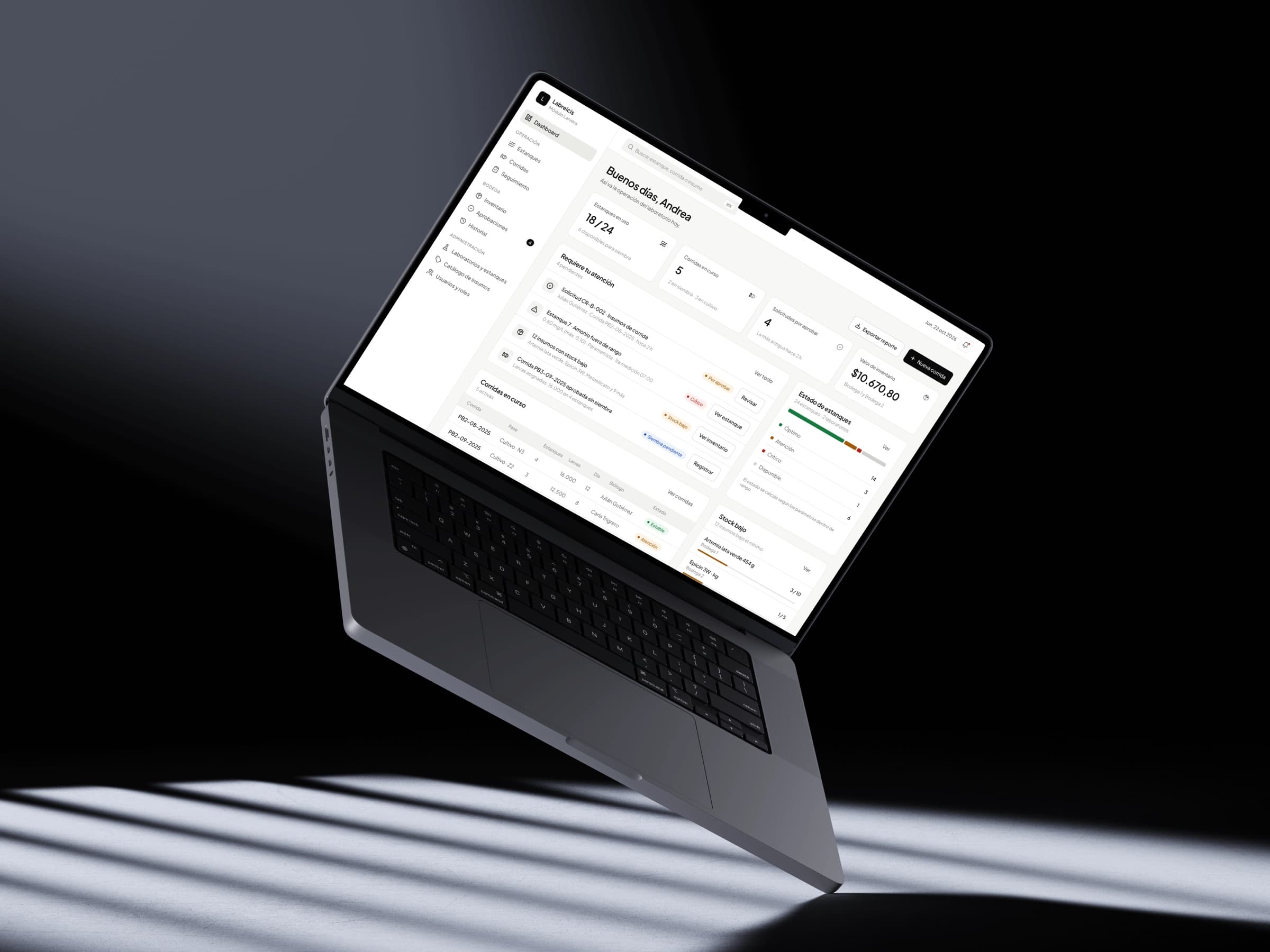
The dashboard wasn't designed as a report but as the starting point of the shift. It greets whoever logs in and shows first what needs their attention.
I designed the platform for desktop and iPad, because much of the work happens outside the office.
Solution
The top of the screen sums up the lab's status in four figures: tanks in use, runs in progress, requests awaiting approval and inventory value.
Below, the "Needs your attention" block gathers into one list what used to arrive through different channels:
- A supplies request awaiting approval.
- A tank with ammonia out of range.
- Supplies running low.
- An approved run that hasn't been stocked yet.
Each alert carries a status label and its direct action: review, view tank, view inventory or log.
The rest of the screen completes the picture of the day: the table of runs in progress with their phase and lead biologist, tank status by range (optimal, attention, critical, available) and the supplies below their minimum.
Learnings
When a system replaces paper and spreadsheets, the first screen has to earn the trust of the people using it: if it shows what's urgent with the action right next to it, it becomes the place where the day starts.
Separating operations, warehouse and administration also helped define roles and permissions clearly.
Does your product have a similar problem?